
No products in the cart.
14
Aug
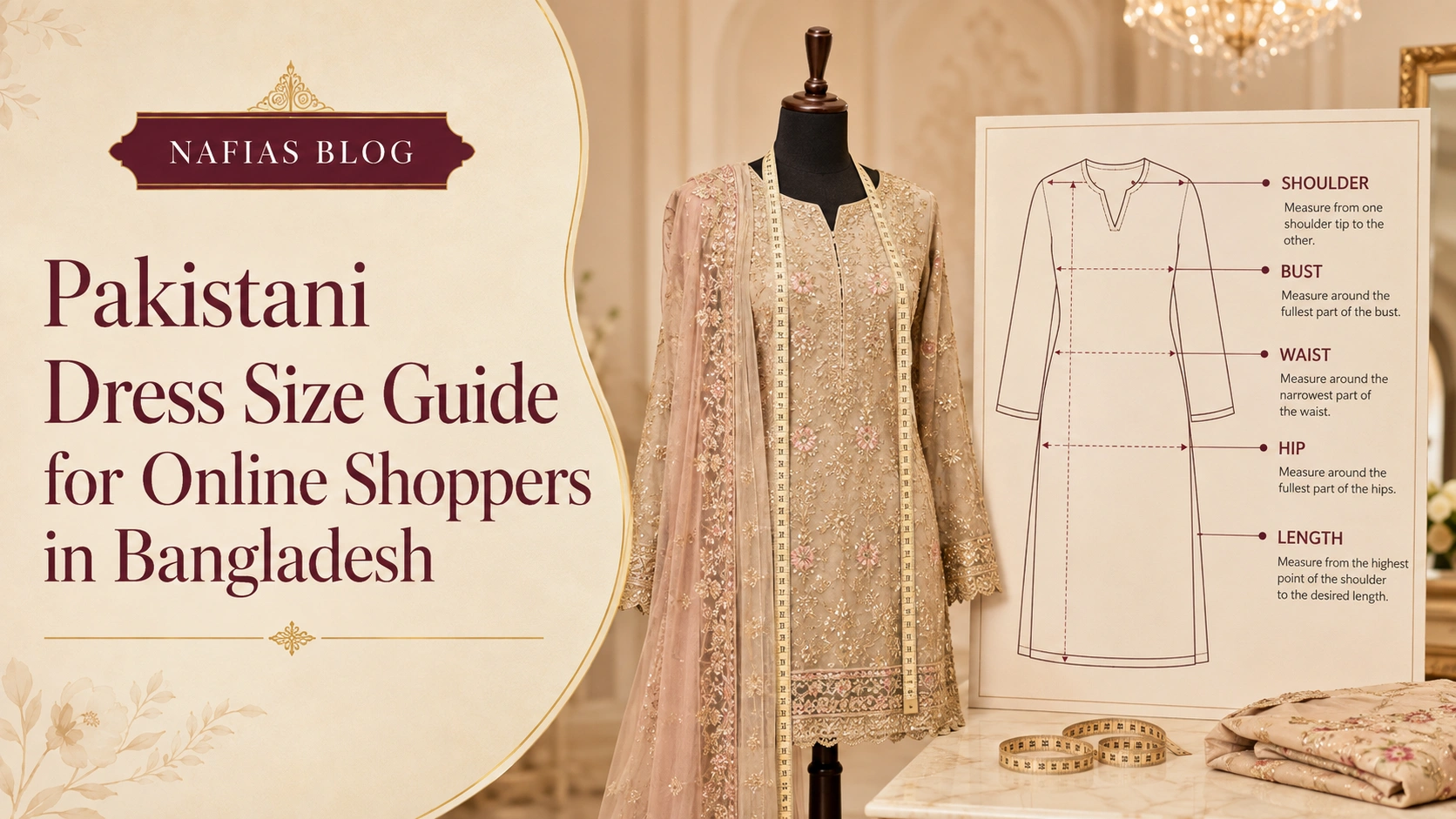
Pakistani Dress Size Guide for Online Shoppers in Bangladesh
Pakistani Dress Size Guide can be easier to choose when you know exactly what to check. Size problems are one of the biggest concerns when buying stitched Pakistani dresses online. A customer may usually wear medium, but the same label can fit differently across brands and dress styles.
The safest approach is to use measurements, not assumptions. This guide explains how to measure yourself and compare a product size chart before ordering.
Article Outline
- How to Use This Pakistani Dress Size Guide Correctly
- Tools you need
- Bust measurement
- Waist measurement
- Hip measurement
- Shoulder measurement
- Armhole and sleeve measurements
- Shirt length
- Trouser measurements
- Lehenga measurements
- Use a favourite garment as a reference
- What to do when you are between sizes
- Common sizing mistakes
- For unstitched Pakistani dresses
- Final thoughts
- Frequently asked questions
How to Use This Pakistani Dress Size Guide Correctly
Body measurements are taken directly around your body. Garment measurements describe the finished dress.
A garment needs extra room, called ease, so you can breathe, sit and move. The amount of ease depends on the fabric and desired fit.
For example, a loose straight shirt needs more room than a fitted formal blouse. A non-stretch fabric such as organza or raw silk needs careful fitting because it cannot expand. For shoppers comparing Pakistani Dress Size Guide, this detail makes the decision easier.
Check whether the seller’s chart lists body or garment measurements. When unclear, ask before ordering.
Tools you need
Use:
- A flexible measuring tape
- A mirror
- A fitted but comfortable outfit
- A notebook or phone
- Someone to help with shoulder and length measurements
Keep the tape level and relaxed. Do not pull it too tightly.
Bust measurement
Measure around the fullest part of the bust. Keep the tape parallel to the floor and make sure it passes comfortably under the arms.
For a garment measurement, compare the flat chest width if provided. Flat width usually needs to be doubled to understand the full circumference.
Allow enough ease for movement, especially when the shirt has no stretch.
Waist measurement
Measure around the natural waist, usually the narrowest area above the navel. Do not hold your breath.
For dresses with a fitted waist seam, this measurement is important. For a loose straight shirt, hip and bust may matter more. When browsing Pakistani Dress Size Guide, check this point before placing an order.
Hip measurement
Measure around the fullest part of the hips and seat. Keep your feet close together.
Hip measurement is important for long shirts, fitted kameez styles, lehenga waistbands and trousers.
Make sure side slits begin high enough for comfortable movement when the shirt is narrow.
Shoulder measurement
Measure across the back from one shoulder point to the other. Incorrect shoulder fit can make the whole dress look too large or too small.
If the shoulders are too wide, the sleeves may drop. If they are too narrow, the fabric may pull around the upper body.
Use a well-fitting dress as a second reference.
Armhole and sleeve measurements
Measure around the upper arm and note your preferred sleeve length.
Formal sleeves with embroidery need extra care. Altering an embroidered sleeve may be difficult if the border placement is fixed. This is one reason Pakistani Dress Size Guide should be compared using complete product details.
Check the cuff opening as well, especially for full sleeves with buttons or fitted cuffs.
Shirt length
Measure from the top of the shoulder near the neck down to your desired hem.
The same shirt may look very different at 42 inches and 50 inches. Consider your height, trouser style and occasion.
For a stitched product, confirm whether the stated length includes decorative lace or fringe.
Trouser measurements
Check:
- Waist
- Hip
- Rise
- Thigh
- Inseam or full length
- Bottom opening
Elastic waist trousers provide some flexibility, but the hip and thigh still need enough room.
For sharara, gharara and wide-leg trousers, ask about the waistband and full length.
Lehenga measurements
For a lehenga, confirm:
- Waist
- Hip if fitted at the top
- Skirt length
- Flare
- Waistband type
- Drawstring or zipper
- Lining and cancan
Measure while wearing the type of shoes you plan to use. A formal skirt that is too long can become unsafe.
Use a favourite garment as a reference
Your best tool may be a dress you already own.
Lay it flat and measure:
Chest
Waist
Hip
Shoulder
Armhole
Sleeve
Shirt length
Trouser waist and length
Compare these measurements with the product chart. This method is especially helpful when you prefer a particular amount of looseness.
What to do when you are between sizes
When the product has non-stretch fabric, choosing the larger size is often safer if alteration is possible. A clear listing helps customers evaluate Pakistani Dress Size Guide with more confidence.
Before ordering, ask whether the dress has seam allowance. Extra fabric inside the seams can help a tailor increase the size slightly.
Do not assume every formal dress can be altered. Embroidery, side panels, zippers and lining may limit adjustment.
Common sizing mistakes
Avoid these mistakes:
- Ordering only by small, medium or large
- Measuring over bulky clothing
- Pulling the tape too tightly
- Ignoring the shoulder
- Forgetting sleeve and shirt length
- Comparing body measurements with garment measurements
- Assuming every brand uses the same chart
- Ordering at the last minute
Save a copy of the size chart used for your order because online pages may later change. Keep this in mind while researching Pakistani Dress Size Guide online.
For unstitched Pakistani dresses
Unstitched products remove the standard-size problem, but accurate measurements are still important.
Ask your tailor to keep a record of your final measurements. Update them before important outfits because body measurements can change.
For complex wedding formals, schedule a fitting before final finishing. This allows adjustments before borders and embellishments are permanently attached.
Final thoughts
A good online fit begins with careful measurement. Spend ten minutes measuring instead of hoping that your usual size will work.
Nafias product pages should show clear measurements for stitched outfits and complete component details for unstitched products. Customers should also confirm exchange conditions before purchasing. For shoppers comparing Pakistani Dress Size Guide, this detail makes the decision easier.
Frequently asked questions
What should shoppers know about Pakistani Dress Size Guide?
Choose based on the measurement chart. A slightly larger size may be safer when alterations are possible and the fabric has no stretch.
How much ease should a dress have?
It depends on the style and fabric. Loose shirts need more ease, while fitted dresses need enough room to move without pulling.
Can embroidered dresses be altered?
Sometimes, but embroidery placement may limit alteration. Ask about seam allowance before ordering.
What is the most important measurement?
Bust, shoulder and hip are especially important for shirts. For lehengas and trousers, waist and length are critical.
Helpful Shopping Links
Explore Pakistani Dress Size Guide products at Nafias for relevant products and current availability.
Before paying, save the listing and size chart; official consumer support is available from the Bangladesh Directorate of National Consumer Rights Protection.
Share:


Leave a Reply